
Aluminum, opened up.

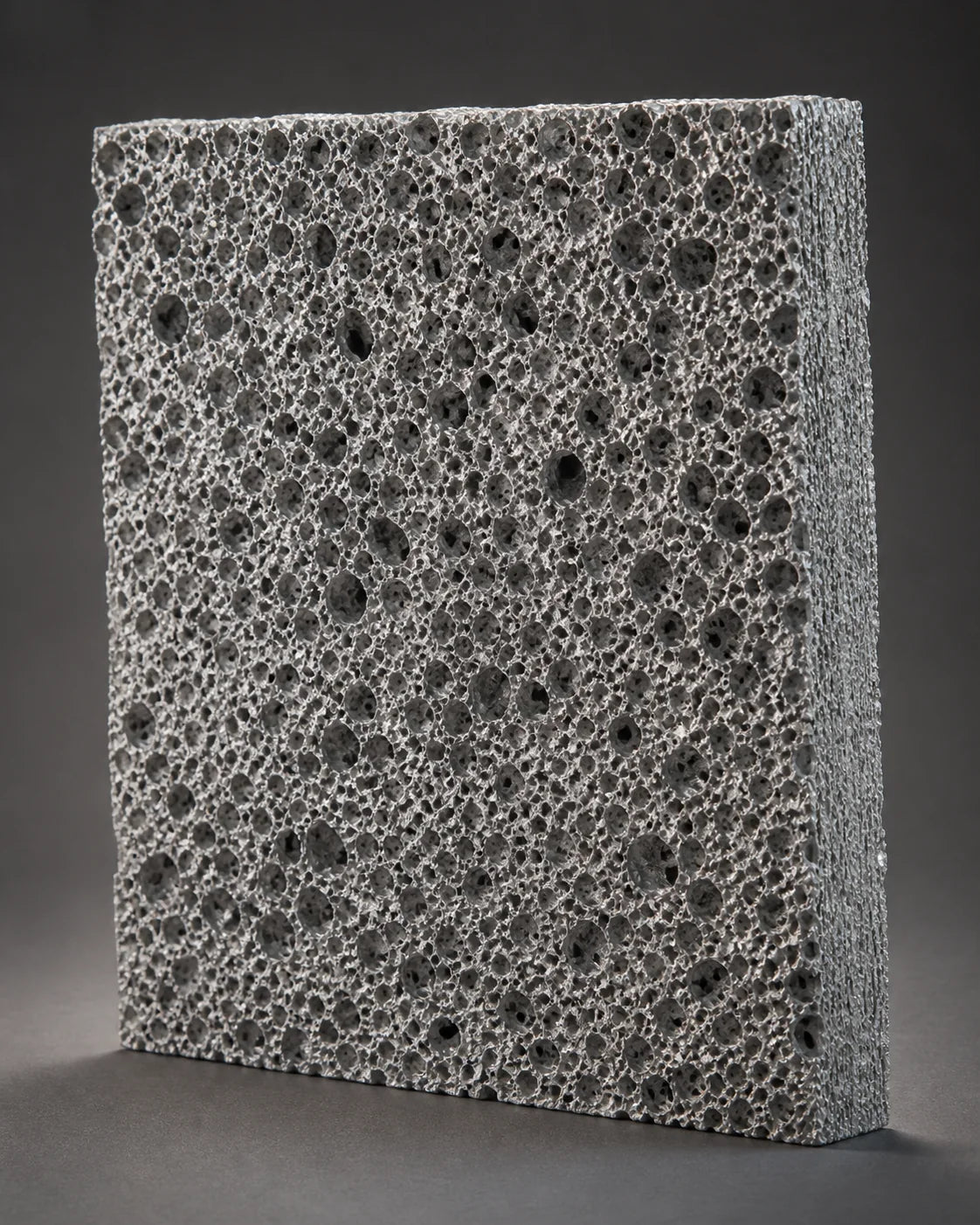
Aluminum foam is aluminum formed around an irregular field of pores. A cut face reveals that interior as a metallic surface.
See how it reads
Thick aluminum foam panel with an irregular metallic pore structure

Metal you can read by sight and hand.

Up close, the face is rough and reflective. The edge shows real depth. In hand, the piece reads as rigid metal, not a printed or molded pattern.

Hands holding a thick aluminum foam sample with its face and edge visible

Surface

Light catches the high points while deeper pores stay dark.

Edge and depth

A cut edge makes the piece thickness and interior structure visible.

Scale

A hand-held sample shows the size of the pores and the piece without an abstract close-up.

Six aluminum foam samples showing a natural range of pore sizes and surface structures

No two cuts match.

Pore size, shape, and placement shift across pieces. That variation belongs to the material; it is not a printed repeat.

Use product photography to understand the expected range. Choose by overall character, not an exact pore map.

Specifications

The panel as supplied.

Open a row for the detail. Anything that depends on the assembly, the finish or the site is confirmed for the project.

Material
Closed-cell aluminum foam. Aluminum through the full thickness: no coating, no core, no backing.
Sample panel
300 × 300 × 20 mm (about 11.8 × 11.8 × 0.8 in), raw sawn face. Sold online in the Standard Kit and the Designer Kit.
Standard sheet sizes
500 × 500, 1000 × 500, 1000 × 1000 and 2000 × 1000 mm. Longer sheets, up to 2500 mm, by inquiry.
Thickness
10 to 100 mm as standard. Thinner sheets by inquiry.
Surface
Raw sawn, with the cell structure open on the face. Pore size, shape and placement vary from cut to cut.
Finish options
Supplied raw. Can be powder coated, painted or epoxy coated; finish samples by inquiry.
Fabrication
Saws, drills, planes and mills with ordinary metalworking or woodworking tools. Edges can stay raw or be finished.
Fixing
Screw-fixed or bonded to light-gauge framing. Ceiling panels bonded, hung on clips or magnet-mounted. Fastener and adhesive selection is confirmed per project.
Weight
Confirmed per batch. Ask for the figure for the size and thickness you are ordering.
Performance data
Fire, acoustic and mechanical results are shared per project for the specific build-up. They are not generalized on this page.
Cell grades

Fine

The smallest, densest pore field. At arm's length it reads as a textured metal surface.

Medium

The middle grade, and the one in the Standard Kit. Pores are readable at room distance.

Coarse

The largest open cells. Deep shadows, the strongest texture, and the most variation between cuts.

All sizes nominal. Cut tolerances are confirmed with the quote.

Six practical questions.

Will every piece look the same?

No. Pore size, shape, and placement shift from piece to piece. Choose by overall character, not an exact pore map.

Is it solid metal?

It is aluminum with an internal field of pores. It reads and handles as rigid metal, and it is lighter than a solid piece of the same size.

Can I cut it in my own shop?

Yes. It saws, drills, planes and mills with ordinary metalworking or woodworking tools. Wear eye protection and collect the swarf; the cut face stays raw or can be sealed.

Do you publish fire or acoustic data?

Not as general numbers. Results depend on the panel, the backing and the assembly, so we share them per project for the build-up in question. Send the application and we will tell you what applies.

Can I order it online?

Yes. The Standard Sample Kit and the Designer Kit are ordered online. Standard sizes and custom work are quoted by inquiry.

What is the fastest way to evaluate it?

Order a Sample Kit, judge the surface and edge in hand, then send the application you are considering.

How to get it.

Sample Kits are ordered online. Standard sizes, custom pieces, and prototypes are quoted by inquiry.

Standard sizes
Tell us the size, finish, and intended use you need. We confirm availability, price, and lead time in writing.
Ask about standard sizes
Standard Sample Kit — $129
One 300 × 300 × 20 mm panel. A focused first look at the metallic surface and its visible variation.
Order the Standard Kit
Designer Kit — $299
Three 300 × 300 × 20 mm panels in fine, medium and coarse cell grades, plus a technical data sheet and one project review with our material team.
Order the Designer Kit
Custom and prototype work
Start with a defined application, then request a quote. Feasibility and terms are reviewed by inquiry.
Request a Quote

Know the material. Then the people.

Review the professional material path, or read how VORALOY works and where the material comes from.